
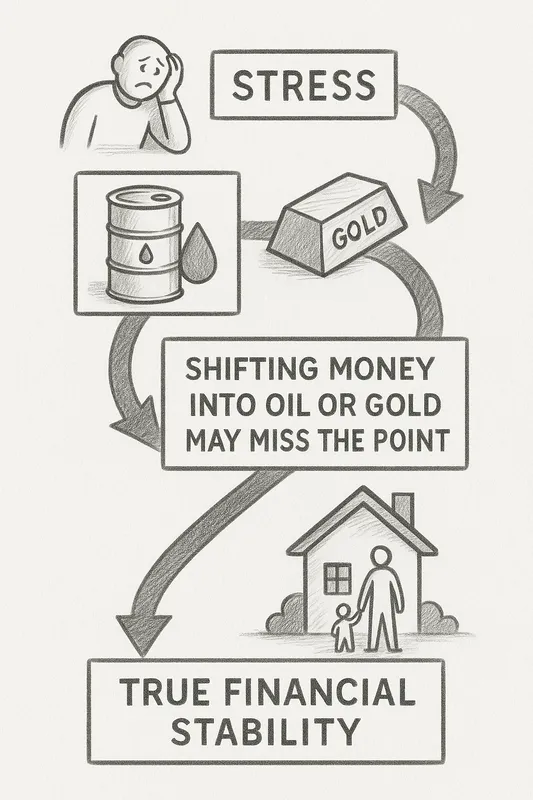
A client called during a tense week, wanting to shift money into oil or gold. If prices spiked because of the conflict, he figured a big profit might take the edge off the stress everyone was feeling. We had just reviewed his portfolio. Nothing dramatic had changed. His investments were diversified, his retirement plan was on track, and his family was financially secure. What had changed was how he felt.
Reaching for financial solutions to emotional problems
When the world feels uncertain, it is natural to reach for financial solutions. If the future looks unstable, people often assume that having more money will restore a sense of calm. That is why periods of geopolitical tension bring waves of speculation. Investors suddenly become interested in assets that might benefit from turmoil.
The thinking goes something like this: if the situation is stressful, profiting from it will soften the blow.
But that instinct misunderstands what money can actually do. Knowing you can pay your bills, support your family, and prepare for retirement provides real stability. A thoughtful plan built on savings, diversified investments, and disciplined decisions protects families against many of life’s uncertainties. But even the strongest plan has limits. If oil prices doubled tomorrow, this client’s daily life would change some, but his life wouldn’t shatter. His family would still live in the same home, his long-term plans would remain intact.
The question worth asking
People often ask how much money they need to be happy, as though happiness were tied to reaching a specific number. But the better question is: how much do I need to live the life that matters to me?
Financial resources provide security, options, and freedom. Beyond a certain point, though, more money does not necessarily translate into greater satisfaction. Our tradition recognized this long before economists studied the subject. Pirkei Avot asks, “Who is rich?” The answer: “One who is happy with his portion.”
Building financial stability is responsible and important. But the things that sustain people through difficult moments are rarely found in a brokerage statement. They are found in family, community, and shared strength. Money can support those things. It was never meant to replace them.
If you would like to talk about building a plan that fits your actual life, visit profile-financial.com/call or call 02-624-2788.
Douglas Goldstein, CFP® is the director of Profile Investment Services, Ltd. profile-financial.com. He is a licensed financial professional both in the U.S. and Israel. Call (02) 624-2788 for help with your U.S. brokerage and IRA accounts. Securities offered through Portfolio Resources Group, Inc. Member FINRA, SIPC, MSRB, FSI. The author’s opinions are not necessarily those of PRG or its affiliates. Neither PRG nor its affiliates provide tax or legal advice.
Published November 3, 2026.