
A client recently called with what sounded like a simple question: His CD (certificate of deposit) was maturing. What should he do with the money?
But once we looked at the whole account, a more interesting question emerged.
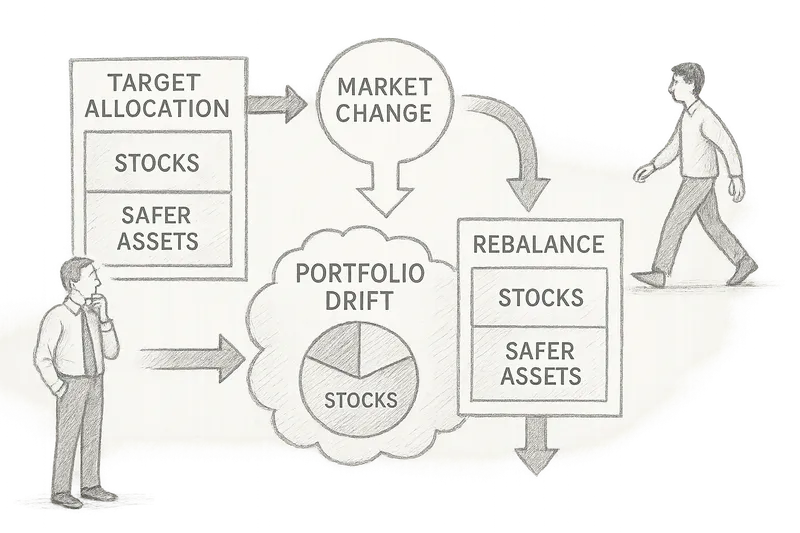
His portfolio had been designed to hold roughly half in stocks and half in more stable investments. Over time, though, those percentages had shifted.
No dramatic decision caused it. Markets moved. Investments matured. Cash accumulated. Little by little, the portfolio changed.
That’s portfolio drift
Portfolio drift happens naturally. If stocks rise faster than bonds, they become a larger share of the account. If stocks fall, bonds and cash may take up more space.
The instinct may be to “fix” the percentages and get everything back to target.
But that’s not always the right answer.
Before changing anything, ask a more important question: Does the original plan still make sense?
In this case, the client had owned considerably more stocks years earlier. His allocation was later reduced because a more balanced approach better matched his stage of life.
Now he wondered if this was a good time to increase stocks again.
That was the real decision… not where to put the maturing CD.
Had his goals changed? Did he need less liquidity? Was he comfortable taking more risk? Had anything important in his financial life changed?
The answer was no.
So there was no reason to let a maturing investment, nor recent market performance, push him into taking more risk than his plan called for.
The cash had another job
His portfolio already included short-term bond funds and CDs maturing at different times. That liquidity meant he could get money when he needed it without being forced to sell stocks during a bad market.
That’s the bigger lesson.
When a CD matures, don’t just ask, “Where should I reinvest this money?”
Ask, “Does my whole portfolio still fit my life?”
If you’re an American living in Israel and would like to review your U.S. investments, visit profile-financial.com/call or call 02-624-2788.
Douglas Goldstein, CFP® is the director of Profile Investment Services, Ltd. profile-financial.com. He is a licensed financial professional both in the U.S. and Israel. Call (02) 624-2788 for help with your U.S. brokerage and IRA accounts. Securities offered through Portfolio Resources Group, Inc. Member FINRA, SIPC, MSRB, FSI. The author’s opinions are not necessarily those of PRG or its affiliates. Neither PRG nor its affiliates provide tax or legal advice.
Published October 27, 2026.