
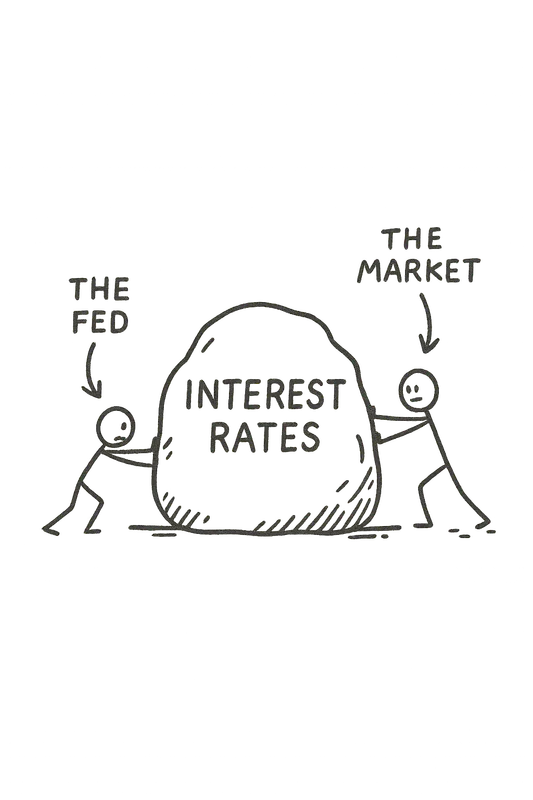
When U.S. interest rates rise, people often say, “The Fed raised rates.” That is true, but only partly so. The Federal Reserve has enormous influence over short-term interest rates. When it raises its benchmark rate, borrowing becomes more expensive across the economy. Credit cards, business loans, and short-term financing often react quickly. But the Fed does not sit in a room and decide what the 10-year Treasury yield or a mortgage rate should be. Those rates are set in the market.
How long-term rates actually move
Investors constantly decide how much return they require to lend money for five, ten or thirty years. Their decisions depend on inflation expectations, economic growth, government borrowing and simple supply and demand.
That distinction matters. If investors worry that inflation will remain high, they may demand a higher yield before locking up money for a decade. If the U.S. government issues more Treasury bonds, yields may rise to attract enough buyers. Long-term rates can climb even without a new Fed rate hike.
The opposite can happen, too. If investors fear a recession, they may rush to buy Treasury bonds, pushing prices up and yields down before the Fed changes anything.
Why this matters for your portfolio
For Americans living in Israel managing U.S. brokerage or retirement accounts, the practical question isn’t, “What will the Fed do next?” It’s, “What happens to my portfolio if rates move in either direction?”
If you need money in two years, it may not make sense to lock it into a twenty-year bond just because the yield looks attractive. If you want predictable income, CDs (certificates of deposit) or shorter-term bonds may be more appropriate. And if you own longer-term bonds, you should understand that their prices can move significantly as market rates shift.
The bigger picture
The Fed matters, but it is only one player in a much bigger market. Investors who understand that are less likely to be caught off guard. Want a simple, entertaining way to understand how interest rates affect real people? Watch my short “Monkeys” story at profile-financial.com/monkeys.
Douglas Goldstein, CFP® is the director of Profile Investment Services, Ltd. profile-financial.com. He is a licensed financial professional both in the U.S. and Israel. Call (02) 624-2788 for help with your U.S. brokerage and IRA accounts. Securities offered through Portfolio Resources Group, Inc. Member FINRA, SIPC, MSRB, FSI. The author’s opinions are not necessarily those of PRG or its affiliates. Neither PRG nor its affiliates provide tax or legal advice.
Published October 20, 2026.