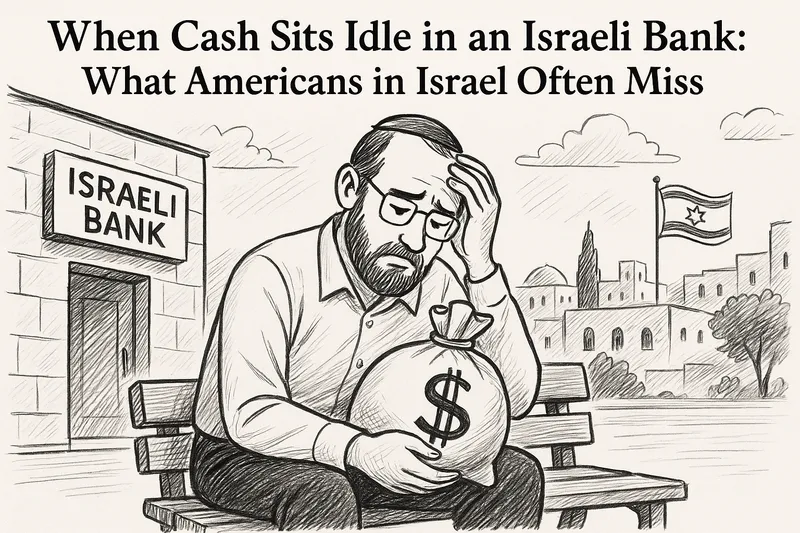
A client called recently with good news. After more than 15 years at a tech company, he had cashed out his options following an acquisition. After taxes, he had a significant sum in dollars sitting in his Israeli bank account. But when he looked at what the bank offered for a dollar-denominated deposit, he was stunned: locking the money up for 12 months would earn him barely over 1%.
He hesitated to convert the dollars to shekels, hoping the exchange rate would improve. So the cash just sat there while he tried to figure out what to do next.
The hidden cost of waiting for a better rate
Many Americans living in Israel face this exact situation. They hold dollars in an Israeli bank, reluctant to convert at an unfavorable rate, but unsure where to park the money in the meantime. The exchange rate feels like the main decision, so everything else gets delayed.
What often gets overlooked is the opportunity cost. While waiting for a better rate, the money earns almost nothing. The difference between what an Israeli bank offers on a dollar deposit and what American bank CDs or a U.S. money market account pay can be substantial. On a six-figure sum, that gap can mean thousands of dollars lost each year. The Israeli bank doesn’t pay more because it doesn’t have to. Clients often choose convenience and inertia over return, and the cost quietly compounds.
Consolidation creates clarity
The second issue was fragmentation. This client had funds in an Israeli bank, an old U.S. brokerage account from stock options years ago, and a long-term portfolio. Each account had a purpose at one time, but together they created blind spots. It became harder to see the full picture, rebalance sensibly, or plan withdrawals in retirement.
I often see families holding multiple accounts out of habit rather than strategy. Consolidating doesn’t mean giving up control; it means creating a structure that supports better decisions and captures returns that would otherwise be lost to friction, fees, or low-yielding deposits.
If you are holding significant cash in an Israeli bank or managing U.S. assets across multiple accounts, it may be worth reviewing your structure. Small inefficiencies add up. To discuss your situation, schedule a free introductory call at profile-financial.com/call or call 02-624-2788.
Douglas Goldstein, CFP® is the director of Profile Investment Services, Ltd. www.profile-financial.com. He is a licensed financial professional both in the U.S. and Israel. Call (02) 624-2788 for a consultation on how to set up your American assets to meet your financial goals. Securities offered through Portfolio Resources Group, Inc. Member FINRA, SIPC, MSRB, FSI. Accounts carried by Pershing LLC., Member NYSE/SIPC, a subsidiary of The Bank of New York Mellon Corporation. The opinions expressed are those of the author and not those of Portfolio Resources Group, Inc. or its affiliates. Neither PRG nor its affiliates provide tax or legal advice.
Published September 1, 2026.