
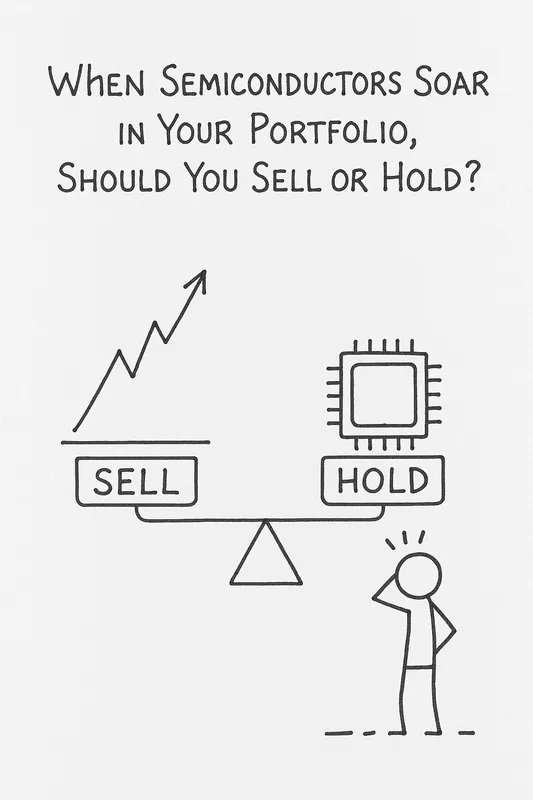
A client called while commuting between cities in Israel. The connection was noisy, but the question came through clearly: semiconductors had been performing exceptionally well in his portfolio, and he wanted to know if it was time to trim before a correction.
We reviewed his holdings. He owned several major chip stocks and a semiconductor-focused fund. On top of that, the broad index funds in his portfolio held significant positions in the same sector. He was, as he described it, heavily concentrated in semiconductors.
The question was straightforward. The answer was not.
Selling after strong performance feels prudent
His instinct made sense on the surface. A sector runs up sharply, and selling at a high to buy back lower sounds like smart risk management. Many investors feel uneasy watching a concentrated position grow, especially when headlines remind them that corrections happen.
But that reasoning assumes you can time the market. It assumes you will recognize the peak before it arrives and the bottom before it rebounds. In practice, few investors do this consistently. Selling after strong performance often means locking in gains just before further growth. Waiting for a dip can mean sitting in cash while the position keeps climbing.
I asked whether he thought demand for semiconductors was slowing. He did not. He believed a correction might come eventually, but the long-term trajectory still looked strong.
Long-term conviction matters more than short-term discomfort
The real question was not whether semiconductors had performed well. It was whether he was a long-term investor or a trader trying to capture short-term price movements.
He said he was a long-term investor. That answer mattered more than recent price action. Over time, I see clients struggle with this tension. A position grows, discomfort sets in, and the urge to act becomes hard to resist. But acting on discomfort rather than a fundamental change in outlook often leads to regret.
If the thesis behind owning these companies had not changed, and if his risk tolerance still supported the allocation, trimming based on recent gains alone might do more harm than good. Portfolio decisions rooted in market timing rarely outperform disciplined strategies.
He decided to hold. That may not have been the most exciting answer, but it aligned with his goals and his view of the fundamentals. Sometimes the best move is the one you do not make.
If you are unsure whether recent gains require action, a professional review can help. Schedule a free introductory call or contact the office at 02-624-2788.
DISCLAIMER: Douglas Goldstein, CFP® is the director of Profile Investment Services, Ltd. www.profile-financial.com. He is a licensed financial professional both in the U.S. and Israel. Call (02) 624-2788 for a consultation on how to set up your American assets to meet your financial goals. Securities offered through Portfolio Resources Group, Inc. Member FINRA, SIPC, MSRB, FSI. Accounts carried by Pershing LLC., Member NYSE/SIPC, a subsidiary of The Bank of New York Mellon Corporation. The opinions expressed are those of the author and not those of Portfolio Resources Group, Inc. or its affiliates. Neither PRG nor its affiliates provide tax or legal advice.
Published June 2, 2026.